Thursday, October 28, 2010

Peru - Amazon Jungle


Today we flew to Peurto Maldonado, a small town on the banks of Madre de Dios, a river tributary of the Amazon River. We had a quick look around town before boarding our transfer boat which would take us to our Eco Lodge in the Amazon Jungle. We also said hello to our new group members, two who would join us for the next week or so and a family of three who would join us just for the next couple of days in the jungle.
Our amazing first lunch at the lodge was chicken and risotto wrapped in a large leaf similar to a banana leaf. After lunch we went across the river to Monkey Island. This is an island that is owned by the lodge and is used as a rescue centre for monkeys that were being sold on the black market and also those that had been illegally kept by locals as pets. Whilst here we gave the monkeys a little snack of bananas and enjoyed watching them play. There were four breeds of monkeys, Black Spider Monkeys, Black and White Capuchin and Saddleback Tamarinds They were all very cute.
After dinner we went Caiman spotting. We travelled up the river with spotlight and saw a number of Caimans sitting on the river edge. The biggest they grow is around 2m but none we saw were even close to that size. 
Caimans are the South American version of the crocodile but are nowhere near as big, aggressive or exciting.

Wednesday, October 27, 2010

Peru - Cusco

Another bus trip today, this time from Puno to Cusco. The trip was 7h but the bus was very comfortable. The scenery was also beautiful.
We arrived in the cool city of Cusco around 3pm and after settling into our hotel we went on a small walking tour with our guide around the old centre. Cusco is a small city with a lot of character, hopefully we get enough time to explore it properly.

Tuesday, October 26, 2010

Peru - Lake Titicaca

After breakfast we said good bye and thank-you to our families and boarded the boat again to head back to Puno.
On our way back we stopped at the nearby island of Taquile where we took a very scenic walk up and around the mountain that the town is situated to the main square. With its ancient customs and strong cultural and ethnic traditions, Taquile is famous for its textiles and fine craftsmanship. We explored this little town before enjoying yet another delicious lunch of fresh Trout overlooking the spectacular bay.
After lunch we boarded our boat again for our 3h return journey to Puno.

Monday, October 25, 2010

Peru - Lake Titicaca

This morning we were met by our guide who was going to take us out onto the lake for the next couple of days. We boarded our boat and met 2 other travel companions and set off bound for the Uros floating islands. The floating islands are man-made islands which have been constructed from reeds and each island is a separate village. We stopped off at one of the islands in the Uros group and met the community who lived there, primarily the women as the men were off fishing. They welcomed us with a few songs and then proceeded to show us their homes which are also built from reeds. The couple of men who were there showed us how the island was built and the structure of the island (by cutting a small section of the island out and lifting it up so we could see). It was fascinating. 
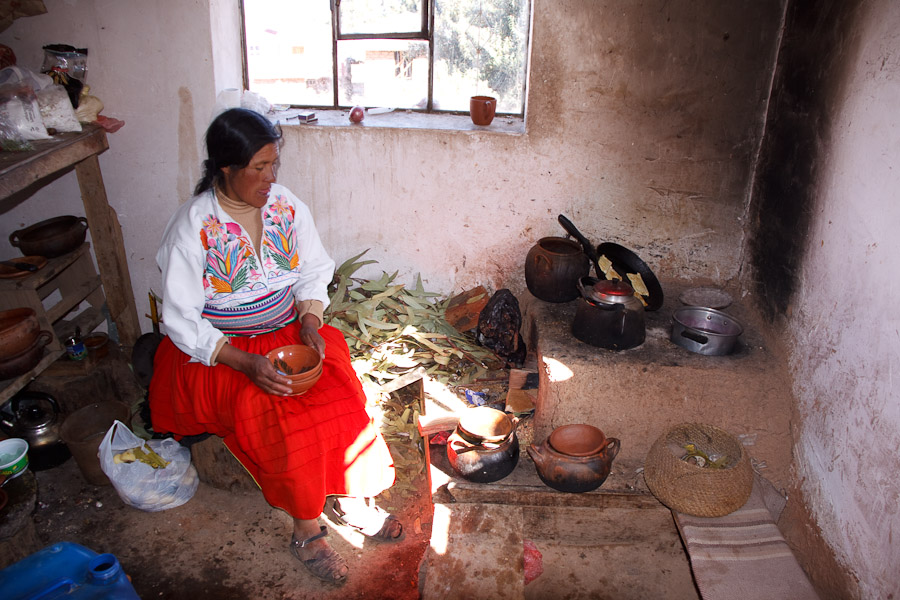
After visiting this island we stopped off at one more and then set off again for our 3h journey to Amantani, the island where we were to spend the night with one of the local Aymaran/ Quechuan families. We arrived around lunch time and were met at the wharf by our families. Our family was a sweet husband and wife and their 13yo daughter, Nellie. Our mama took us to our home and made us a delicious lunch of Quinua (a South American grain similar to rice) and vegetable soup, followed by a delicious fried cheese with rice and potato. Later in the afternoon we all reunited for a soccer match between the local men and the tourists (there were quite a few different groups on the island - thankfully a lot of Europeans). We then walked up the mountain on the island to an area used by the locals to give offerings to Pacha Mama and Mama Qocha(Mother Earth and Mother Lake) for sunset. This walk took us to an altitude of 4160m and gave us an amazing view of the surrounding lake and sunset.  After sunset we made our way back to the village for a hot chocolate with Baileys and then home for dinner. We enjoyed a nice simple dinner with our family and had a great chat with Papa and Nellie in broken Spanish and English, our mama only spoke the local language of which we had just the basics on a phrase sheet. After dinner mama dressed us up in traditional clothes and Nellie took us to the dance that had been organised for us. This was quite fun as we were all there in traditional clothes and dancing traditional dances, it was very amusing.

Sunday, October 24, 2010

Peru - Puno

We spent this morning driving the shores of Lake Titicaca on our way to Puno in Peru, a small town on the shores of the lake and our gateway to our home stay. To get to Puno we drove to Estrecho de Tiquina and caught a small ferry across the passage, our bus came across on a separate ferry. From here we drove to Copacabana where we enjoyed fresh Trout for lunch (soup + a whole Trout, rice and salad for $6 AUD!!) and then changed to a Peruvian bus to come across the border.
Lake Titicaca was the most sacred body of water in the Inca Empire, as according to legend, it gave birth to the Incan Civilisation. Being 176km long and 50km wide and sitting at 3810m altitude, it is the highest navigable lake in the world and forms the border between Peru and Bolivia.

Saturday, October 23, 2010

Bolivia - La Paz

After breakfast a small group of us were picked up and taken on a tour of La Paz. Firstly we drove to Mallasa, or ‘Moon Valley’ as it is known to tourists, which is just on the outskirts of the city and is an area of natural clay formations which are constantly changing due to erosion. The area was once part of the floor of the sea that connected the Uyuni Salt Flats to Lake Titicaca. It was a very cool landscape especially given it was so close to the city. We then drove through ‘The South’, the most expensive of La Paz’s 3 areas and classes of housing. The South which sits at 3200m altitude and is expensive owing to its warmer climate, Centro which sits at 3600m is around the city centre and is considered a middle class area, and The North which sits at 4000m and is the area built on the surrounding mountains and is the poorest section of La Paz. The South is very Americanised. Driving through the shopping district one could be anywhere in the western world. The houses are mansions and the schools exclusive. It was astounding to see the vast contrast between the 3 regions within the city. On the tour we also saw the main square in the colonial area of La Paz which is located in the Centro region. It has the government house, the main official Catholic church and some other government buildings on its edges. As well, we saw the famous San Pedro Prison (from the book ‘Marching Powder’), and we went to an awesome view point which gave us a 360ยบ view of La Paz. Our last stop was the “witches market” which is not actually for witches but has an eclectic range of things to buy from traditional products used for offerings to the traditional gods to souvenirs and alpaca and llama woollen products. 
Tonight we enjoyed a fabulous Japanese meal at a Thai/Japanese/Indian restaurant for our tour guides birthday.

Friday, October 22, 2010

Bolivia - La Paz

Up early this morning ready for our adventure to the worlds most deadliest road. Yes, thats right we were venturing to “Death Road” in Bolivia, but instead of driving along this deadly road we rode down it on mountain bikes! Our days activities were to ride 64km downhill and drop over 3500m in altitude... and try not to fall off the cliff that is the edge of the road.
The drive to our start point was very scenic but did worry us a little as the higher we went the more snow there was on the edges of the road and on the mountains. The thought of riding through ice was not all that nice... but at least it wasn’t raining like it was last night!
We reached our start point, received our final briefing from our guide and set off. The first section was 22km and actually part of the new road so was sealed. It was a beautiful ride and thankfully, although the ambient temperature was below freezing, there was no ice on the road. The second section was the true ‘Death Road’. It was 34km of downhill dirt road that is, in parts, way too narrow for 2 cars to pass each other. It was a little scary at times but mostly just full of absolutely spectacular scenery. Thankfully since the building of the new road approximately 4yrs ago the amount of vehicle traffic on the old road, which is the ‘Death Road’, consists almost entirely of support vehicles for the mountain bikes and tourists who decide it is a good idea to drive the road... silly! The third section is still the old road but is slightly wider and has a couple of flat sections. We finished in a small village at a very low and warm 1200m altitude and enjoyed a nice cold beer!
Our fantastic day was topped off with a great dinner at an English Pub... yes there is one almost everywhere! We also bid farewell to 2 of our group members tonight as their tour finished which left just 5 of us.